The Invoice You Never Think About
Restaurant operators are meticulous about food cost, labour cost, and rent. Yet most have never calculated the total annual cost of their printed menu — because the expense is distributed across the year in small, easily ignored increments.
A typical 40-item restaurant menu, printed professionally with lamination on cardstock, costs between A$8 and A$25 per copy. A dining room of 40 covers needs at minimum 20 menus. Most restaurants replace their menus two to four times per year due to wear, staining, and price changes. That's A$320 to A$2,000 per year — before accounting for emergency reprints, seasonal menu changes, or the laminated inserts that somehow always delaminate.
For restaurants with premium menu books, seasonal tasting menus, or venues that reprint whenever a dish goes off the menu, the annual figure ranges from A$500 to A$10,000.
But the printing cost is just the visible expense. The larger costs are hidden in operations — and they're backed by data.
Every Price Change Costs You
Ingredient costs in Australia through 2024 and 2025 were volatile. The Australian Bureau of Statistics reported sustained food inflation above the general CPI rate. Restaurants that reprinted menus to reflect price adjustments absorbed a direct cost every time — printing, labour to distribute, disposal of old stock. Restaurants that held prices too long to avoid reprinting either left margin on the table or absorbed supplier increases in silence.
A QR-based digital menu eliminates this entirely. Updating a price takes fifteen seconds and takes effect immediately across every table in the venue, every time, with no additional cost.
The same applies to 86'ing an item. When a kitchen runs out of a dish mid-service, a digital menu allows immediate removal. On a paper menu, staff must verbally inform every table — creating awkward conversations, disappointed guests, and the occasional forgotten update that leads to an order the kitchen cannot fulfil. This directly contributes to food waste: according to research from tillster.com, real-time inventory synchronisation with digital menus allows restaurants to automatically hide sold-out items and promote slow-moving items as daily specials before they expire.
The Ordering Error Problem: What the Numbers Say
Paper menus and verbal ordering create a chain of potential miscommunications: guest reads or misreads, guest speaks to staff, staff hears or mishears, staff writes or enters, kitchen reads. Each link is a point of failure.
Food industry research estimates that ordering errors occur in 5–8% of all table service interactions. For each error that results in a remade dish, the cost is approximately 1.5–2.5 times the plate cost: the wasted food, the additional kitchen labour, the delay to the table, and frequently a discount or complimentary item to manage the guest's experience.
Digital ordering systems produce dramatically better results. Industry data from lavu.com and octotable.com shows that integrated digital ordering systems improve order accuracy by 23–30%. Kitchen Display Systems (KDS) take this further — restaurants using a KDS report reducing order errors by up to 90% compared to paper ticket systems, because handwriting interpretation, ticket loss, and manual data entry errors are eliminated entirely.
Wait Times and Operational Efficiency
The efficiency gains from digital ordering systems are now well-quantified. According to multi-platform analyses from lavu.com, restaurants implementing integrated QR-ordering see:
- Customer wait time reduction of 20–50%
- Mobile pre-ordering fulfils orders up to 2.4 times faster than traditional methods
- Self-service reduces physical queues by 25–40%
- 77% of restaurants report increased overall operational efficiency
- 61% of restaurants report reduced staff work pressure
For an operator, these aren't abstract metrics. A 30% reduction in wait times means faster table turnover. A 25% improvement in order accuracy means less food waste, fewer comps, and fewer awkward conversations with disappointed guests.
Staff Time Has a Real Cost
Taking a table order in a full-service restaurant typically requires 3–7 minutes: initial approach, answering questions, recording the order, reading it back, and entering it into the POS. In a venue doing 80 covers per service with an average hospitality wage of A$24–$28 per hour, order-taking alone accounts for 40–90 minutes of wage cost per service.
This is not a call to eliminate front-of-house staff. Hospitality is human. But there is an important distinction between value-adding interaction — genuine recommendations, wine pairing, addressing dietary needs — and transactional order entry. Digital ordering handles the transactional element, freeing staff time for the interactions that actually build loyalty.
The National Restaurant Association's 2025 report confirms this perspective: 74% of operators believe technology integration will supplement or augment human labour rather than replace it. And among operators who increased their technology investment over the past two to three years, 69% reported improved operational efficiency and productivity.
Restaurants that have moved to self-ordering QR systems consistently report that staff perceive their work as more fulfilling — because they spend time on the interesting parts of hospitality rather than the clerical parts.
The Kitchen Display System Advantage
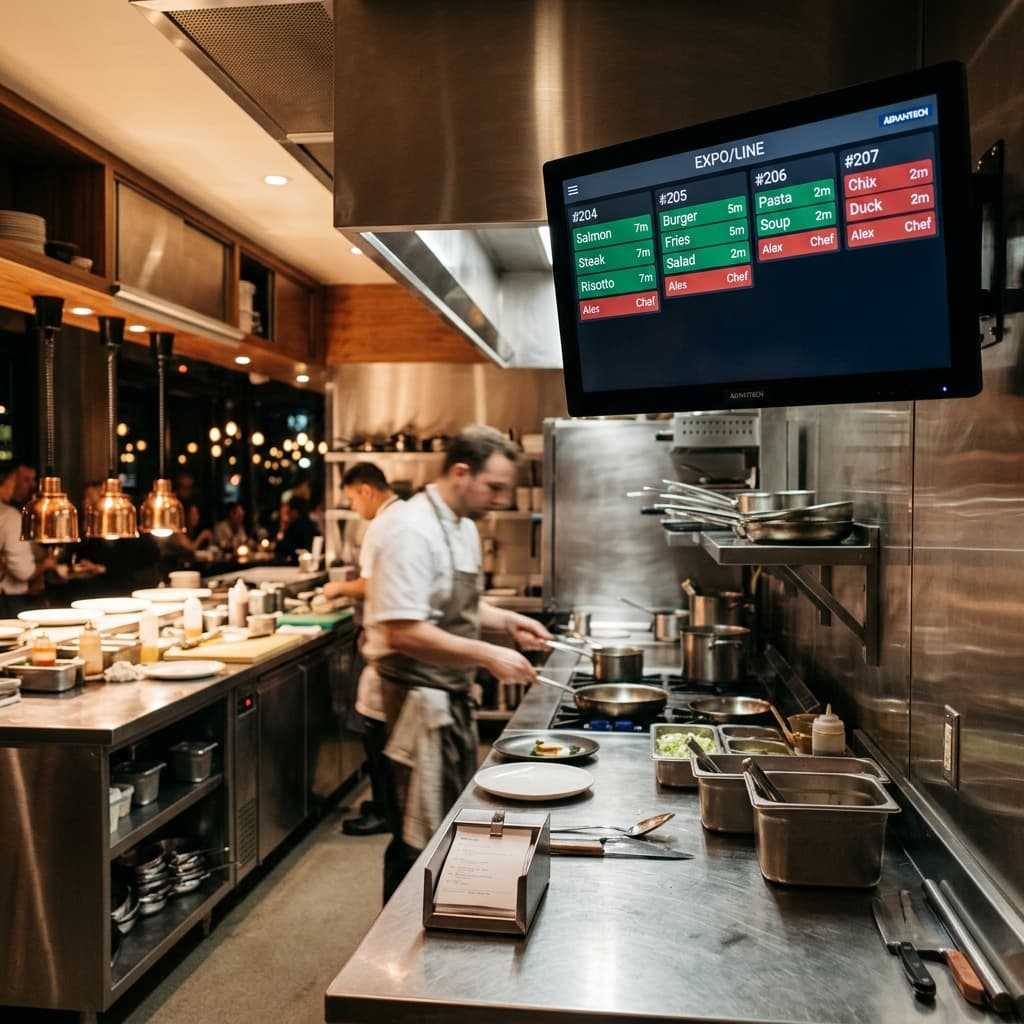
Paper tickets in the kitchen represent a secondary layer of operational cost. They are difficult to read under pressure, easy to lose, impossible to update in real time, and create paper waste.
A Kitchen Display System (KDS) — where orders from guests display on a screen visible to kitchen staff in real time — addresses all of these problems simultaneously. Research compiled by lavu.com and qsrautomations.com reports:
- Kitchen efficiency improvement of 15–25%
- Customer wait time reduction of 20–30% through optimised order sequencing
- Near-complete elimination of ticket-loss errors
- Automatic routing of orders to the correct prep station
- Real-time data on average prep times and bottleneck identification
For kitchen staff, the benefit extends beyond efficiency. A KDS reduces stress during rushes by providing clear, prioritised visibility of the full order queue — replacing the chaos of paper tickets with structured workflow.
The Sustainability Angle
Digital menus contribute to restaurant sustainability in ways that paper menus fundamentally cannot. Research from restauranttechnologynews.com and volantesystems.com documents three specific contributions:
- Paperless operations — eliminating printed menus, order tickets, and receipts reduces paper consumption, printing costs, and the carbon footprint associated with paper production and disposal
- Reduced food waste — real-time menu updates based on inventory prevent orders for unavailable items. Demand forecasting from digital ordering data helps optimise purchasing and reduce overproduction
- Operational energy savings — streamlined order processing and kitchen workflow reduces operational energy consumption
In an era where consumers — particularly younger demographics — increasingly factor sustainability into their dining decisions, this is not a trivial benefit.
The Real Question
Paper menus were designed for an era when the alternatives were a chalkboard or a verbal recitation. In 2026, the alternative is a pixel-perfect digital menu that updates in seconds, speaks every guest's language, lets them order at their own pace, and costs nothing to reprint when you change the soup of the day.
The global restaurant QR ordering market was valued at approximately $7.4 billion in 2025 and is projected to reach $22.1 billion by 2034, growing at a CAGR of 12.9%, according to dataintelo.com. Approximately 75% of restaurants worldwide already use QR codes for menu access.
The question isn't whether digital menus are better. The question is how many more reprinting invoices you want to receive before making the switch.